Common Morocco Scams and How to Avoid Them
Morocco scams are mostly small, repeated tricks that cost money rather than put you at risk: a fake guide, a taxi with no meter, a shop pushed on you after a lie about a closed street. This guide describes the most reported ones in Marrakech and Fes, what the UK government and a 2026 press report say, and the simple habits that avoid most of them. For the wider safety picture, see Is Morocco safe?.
Sources checked on 6 November 2026: the UK government’s Morocco travel advice, a Hespress report of 5 January 2026 on a Backpack Moments study, and several travel guides. Most guides are blogs, so we mark what is only reported. The same Hespress report says Morocco remains a generally safe destination and that most negative experiences involve minor financial losses.
Common Morocco scams at a glance
| Scam | How it works | What to do |
|---|---|---|
| Fake guide | Someone offers to show you the way, then asks for money or leads you to a shop | Politely decline, use a map, hire only badged guides |
| ‘It is closed’ lie | A stranger says a site or shop is closed and offers somewhere else | Check on your map or ask your riad |
| Taxi overcharge | No meter, a ‘broken’ meter or a long route | Ask for the meter, or agree the fare first |
| Inflated market prices | A first price far above the real one | Bargain, and do not accept the first offer |
| Fake products | Argan oil, saffron, carpets or leather sold as rare | Buy from known shops, expect doubt on ‘rare’ |
| Animals and photos | Monkeys or snakes placed on you, then a payment demand | Keep your distance, say no clearly |
The catch is that none of this is unique to Morocco, but the density of tourists in a few places makes it more visible there. Most of it fades once you know the script.
Fake guides and the ‘it is closed’ line
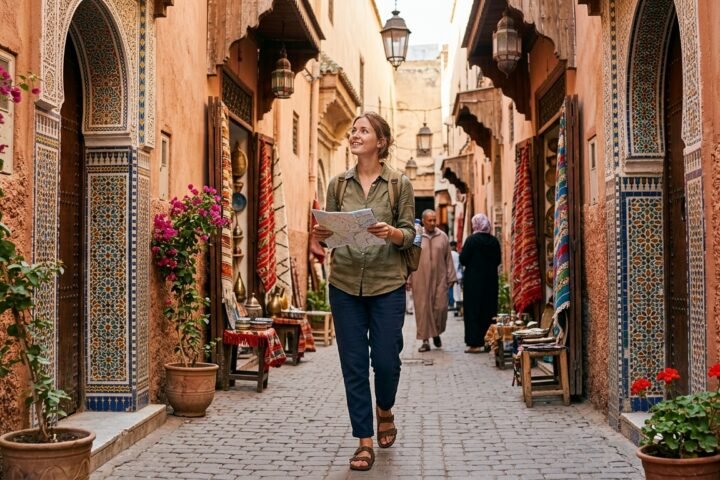
The UK government says it is common for people posing as official tourist guides to harass tourists, and advises using only guides with an official badge and permission from the local authority in medina quarters. Hespress, reporting on the Backpack Moments study, describes misleading directions in old city centres: someone claims a site or shop is closed and sends you elsewhere to earn a commission.
- Walk with purpose and use an offline map, so you do not need to ask the way.
- If you need help, ask a shopkeeper in a fixed shop or your riad host, not someone who approaches you first.
- A polite no, thank you, repeated calmly, is usually enough.
- If you want a guide, book one in advance with a badge, see Fes tours: guided vs self-guided.
Taxis and ride services
The UK government advises agreeing a fare in advance or checking that the taxi is using a meter. It also notes that taxis booked through ride-sharing applications may be unregulated and unlicensed, and that police may tell you to get out of an unlicensed taxi if they stop it. The Hespress report says some drivers, especially at airports or late at night, refuse meters and charge well above official fares, and it warns against unlicensed ride services.
- Ask for the meter before you get in a petit taxi.
- Have a rough idea of the airport fare, see Marrakech airport to the medina and Getting around Marrakech.
- For what is reported about ride apps, see Uber in Marrakech.

Market prices and fake products
Hespress lists inflated market prices as one of the most common issues, and says argan oil, saffron, carpets, leather goods and gemstones are sometimes sold as rare or original when they are not. The UK government warns about scammers substituting inferior goods for the ones you bought. Checking authenticity usually needs expertise most visitors lack, so be sceptical of big claims.
- Bargain politely and do not accept the first price, as the report advises. Our Bargaining in Morocco guide explains the steps.
- Watch the bag as the goods are wrapped, to avoid a swap.
- Be wary of sellers who use pressure, guilt or embarrassment to close a sale.
- For big purchases, ask for a written price and keep the receipt.
Animals, photos and henna in the main square
On Jemaa el-Fna, Hespress says monkeys and snakes are used to attract visitors, sometimes placed on them without consent, followed by payment demands. Some people are also charged for photos taken nearby. A travel guide adds that women offering free henna designs can pressure tourists and demand money afterwards, but that is a single blog’s claim.
Keep a few steps away from the performers, hold your phone when you walk past, and say no firmly if something is placed on you. See Marrakech nightlife for the square after dark.

Theft and card safety
The UK government says petty crime is common in tourist areas, especially medina quarters and beaches, including pickpocketing, bag-snatching and motorcycle theft of visible jewellery and handbags. It also says credit card fraud and scams are common, and to be cautious when asking for directions or using ATMs because aggressive begging is common.
- Wear your bag across the body, on the side away from the road.
- Use ATMs in banks or hotels in daylight when you can.
- Keep cards in separate places and watch the screen when you pay.
- Carry small notes, see Morocco currency and money.
For other planning points, see Morocco travel tips.
If something goes wrong
Stay calm, avoid arguments in a crowded lane and walk away from a pushy seller. If you are robbed or threatened, find the nearest police station or a uniformed officer, and keep your insurance details ready, see Morocco travel insurance. Tourist police are reported in some cities, but we could not confirm current arrangements, and emergency numbers differ between sources, so check them locally.
Frequently asked questions
What are the most common scams in Morocco?
Reports point to fake guides, a stranger saying a place is closed, taxi overcharging, inflated market prices, fake goods and animal-photo demands.
Is Morocco safe for tourists?
A 2026 press report says Morocco remains generally safe and that most negative experiences involve minor financial losses, not personal risk.
How do I avoid fake guides in the medina?
Decline unsolicited help, use a map, and hire only guides with an official badge, as the UK government advises.
Should I use the meter in a petit taxi?
Yes. The UK government advises agreeing a fare in advance or checking the taxi uses a meter.
Are Uber and similar apps safe in Morocco?
The UK government says taxis booked through ride-sharing apps may be unregulated and unlicensed. See our Uber guide for what is reported.
Is it rude to say no to sellers?
No. A polite, calm no and walking on is normal, and sellers expect it.
What should I do if I am scammed?
Walk away from the situation, avoid confrontation and report any theft or threat to the police.
Sources checked
Checked on 6 November 2026. Scam reports come from guides and one press report, and details change.
- UK government, Morocco travel advice: safety and security
- Hespress, common tourist traps in Morocco (5 January 2026)
- World Nomads, common tourist scams in Morocco
- Simply Morocco, scams in Marrakech
Prices and times can change without notice. Confirm them before you pay or travel.